By Jess Ponting
Young people who took part in surf therapy at inland wave pools reported significant improvements in well-being, confidence and social connection, according to a new evaluation by The Wave Project, a British mental health charity. On most measures, the gains were comparable to those seen at the beach, though not on all of them.
The report compared outcomes for 360 participants across 22 beaches and two wave pools during the 2025 season. It is among the first attempts by a major surf therapy provider to compare the two settings directly. Beach programs produced a larger boost in overall well-being, and beach participants were more likely to say they had made new friends.
The findings bear on a question of growing interest as wave pools open in and near cities: whether the benefits associated with surfing can reach young people who live far from the coast.
The study: 360 kids, two kinds of water
The Wave Project runs six-week surf therapy courses for young people facing challenges with mental health, confidence and social connection. It operates 15 hubs and 22 delivery sites across the UK, and it has been an early mover in taking its model inland.
The report, Well-being from Coast to Inland, written by Impact & Research Manager Tim Trythall, analyzed matched before-and-after questionnaires from 360 participants in the 2025 season:
| Setting | Where | Participants |
|---|---|---|
| Beach programmes | 22 coastal sites | 302 |
| Inland wave pools | The Wave (Bristol) and Lost Shore Surf Resort (Edinburgh) | 58 |
Participants were scored on five measures: emotional well-being (the WHO-5 Well-Being Index, 0–100), connection to others (the Inclusion of Other in the Self scale, 1–7), and three 0–4 self-ratings for self-belief, perseverance and pride. At the end, they also answered seven yes/no questions about their experience. The statistical analysis was conducted independently.
Gains in both settings
Young people improved significantly on all five measures in both settings. On four of the five (self-belief, perseverance, pride and connection to others) there was no statistically significant difference in how much they improved between beach and pool.
Connection to others rose by similar amounts in both settings: 0.83 points on a seven-point scale among pool participants and 0.80 among beach participants.
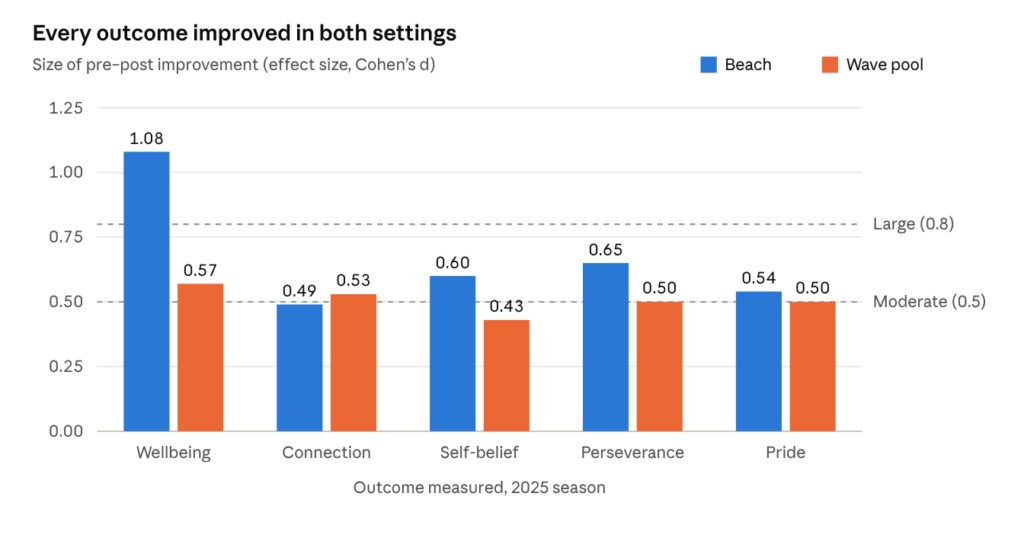
The Wave Project, Well-being from Coast to Inland (2026) · pre–post effect sizes · n = 302 beach, 58 wave pool
Pool participants also rated their relationships with Wave Project staff and volunteers slightly higher (5.41 vs 5.15 out of 7), though the difference was not statistically significant. The charity attributes the consistency across settings to the program’s emphasis on trusted mentoring and achievable challenge, while noting that this is an interpretation rather than a tested finding.
Where the beach came out ahead
On two measures, beach programs performed better.
Well-being. WHO-5 scores rose 20.1 points at the beach and 10.6 in the pools. Both gains were significant, but the beach gain was significantly larger (p = .003). It was the only measure where setting changed the size of the improvement.
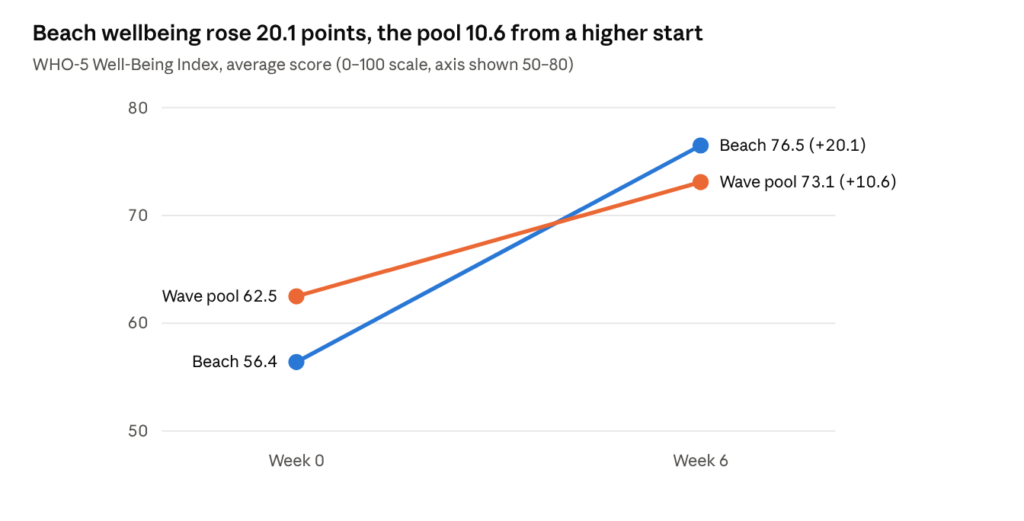
The Wave Project (2026) · WHO-5 averages, week 0 and week 6 · 2025 season
Pool participants, however, started with higher well-being scores (62.5 vs 56.4), and both groups finished at broadly similar levels, leaving the pool group less room to improve. The report cautions that it cannot establish that the coastal environment itself caused the larger gain.
Friendship. 81.5% of beach participants said they made new friends, against 69.0% at the pools. On every other experience question (having fun, feeling valued, forgetting worries), the two settings were statistically indistinguishable.
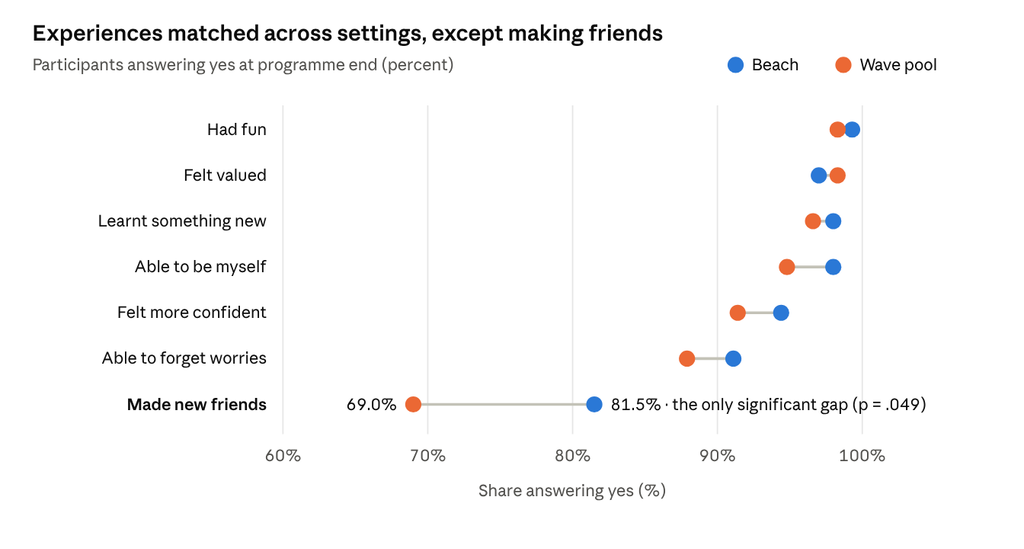
The Wave Project (2026) · post-program experience questions · n = 302 beach, 58 wave pool
A wave pool practitioner quoted in the report offered one possible explanation. Beach sessions may leave more informal time for young people to talk “between sets” or on “flatter days,” while pool sessions run to a tighter schedule, with a new wave every few minutes. The evaluation did not test that explanation.
The question of access
The report frames inland delivery primarily as a way to widen access to mental health support for young people.
It cites a 2025 analysis by the Centre for Young Lives, which found that only two of 21 Integrated Care Boards in England had a dedicated mental health strategy for children and young people, and that investment in community-based support varied widely by region. Access to water is also uneven:
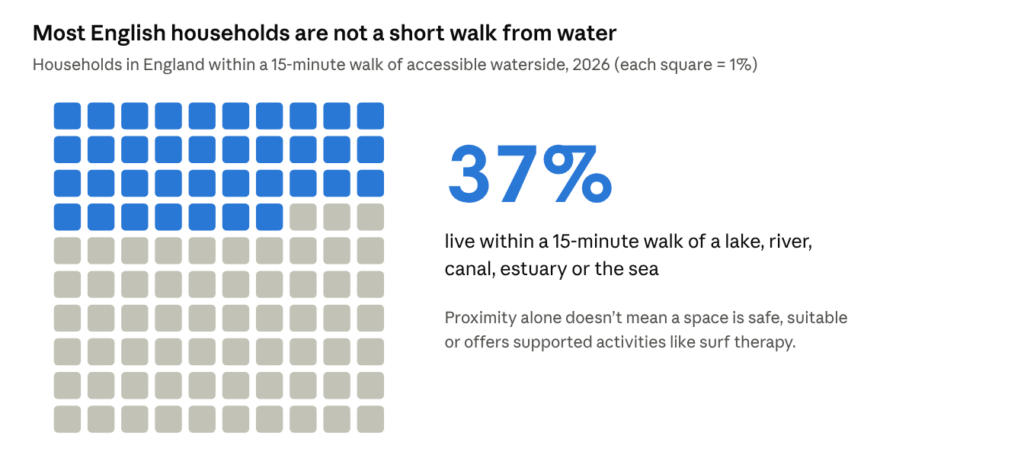
DEFRA, Access to Green and Blue Space in England (2026), as cited by The Wave Project
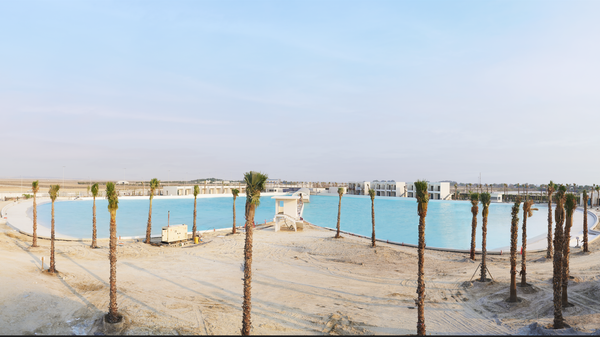
Wave pools such as The Wave near Bristol and Lost Shore near Edinburgh put surfing within reach of urban populations. The Wave Project notes that a wave basin does not by itself remove barriers such as transport, referral routes or unequal inclusion, and says future evaluations should examine whether young people can actually reach, afford and fully take part in programs.
Pools also offer predictable conditions, which may suit a fixed six-week program, although the report did not examine this.
Implications for operators
The friendship finding may be the most practical for wave pool operators. The Wave Project says its next step is to “explore opportunities for greater informal peer connection within structured wave pool delivery.” Possible approaches include:
- Building unstructured social time into sessions, such as a shared warm-up, a snack break on the deck or a post-surf debrief
- Designing spaces where participants can hang out between waves, not just queue for them
- Talking with therapy partners about pacing, since not every session has to maximize wave count
The evaluation was produced by The Wave Project about its own programs, although the statistical analysis was conducted independently.
Limitations
The report acknowledges several limitations. There was no control group of young people who didn’t take part, so it shows change alongside surf therapy rather than proof it was caused by surf therapy. Kids weren’t randomly assigned to beach or pool. The pool group was small (58 vs 302), the two parks were pooled, and it’s a single season. The Wave Project plans to grow the inland sample, compare year on year and add qualitative work on why well-being and friendship patterns differ.
What comes next
Taken together, the findings suggest that wave pools can deliver many of the outcomes associated with surf therapy, including gains in confidence, perseverance, pride and social connection. The ocean retains an edge on overall well-being and on friendship formation.
For supporters of inland surfing, the larger implication may be reach. Most households in England are not within a short walk of accessible water, and wave pools are increasingly being built near population centers.
The Wave Project plans to repeat the comparison each year with a larger inland sample, which should show whether the differences between settings persist. It describes the work as a foundation for a delivery framework, which it calls its BLUEprint, for offering surf therapy across both coastal and inland communities.
Source: The Wave Project, Well-being from Coast to Inland: Comparing Surf Therapy programme outcomes across beaches and inland wave pool settings in the UK (2026).












You must be logged in to post a comment Login