By Jess Ponting
Surf parks don’t sell waves—they sell scheduled, perishable inventory. As demand shifts from destination travel to routine participation, the challenge has shifted from attracting interest to consistently filling sessions.
In a recent Surf Park Central article, we examined how surf park demand is beginning to shift. Travel distances are shortening, dwell times are decreasing, and facilities are becoming more embedded within mixed-use developments and residential communities. What was once a destination-driven experience is increasingly taking on the characteristics of routine recreation. As surf parks move closer to population centers and into more regular participation patterns, the implications shift from demand alone to how operations must evolve in response. These questions will be front and center at Surf Park Summit 2026, where experienced operators will share how they are adapting session programming, pricing, and membership models to better align with this changing demand.

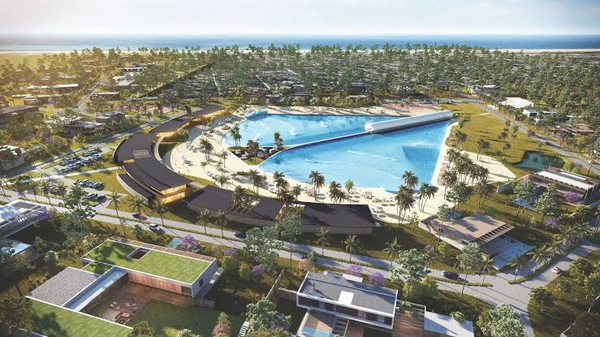
More than 12 surf parks opened across 2024 and 2025, with 10 projected to open in 2026 and as many as a dozen more in 2027. If current projects are completed as planned, the global inventory of surf parks could grow by 250 percent within three years. At that scale, success is no longer defined by the ability to generate waves, but by the ability to convert demand into fully utilized sessions across a structured schedule of surf products.
From Evolving Demand to Session Utilization
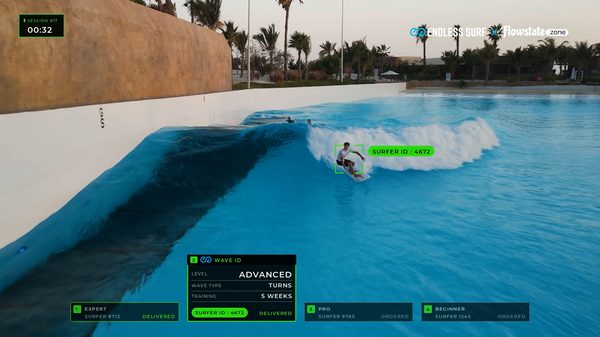
Surf parks are inherently structured environments. Most facilities run hour-long sessions tied to specific wave settings, each designed for a relatively narrow band of surfer ability. A beginner lesson, an intermediate progression session, and an advanced performance wave are distinct products with distinct audiences. As a result, demand must be understood not only in aggregate, but in terms of how well it aligns with these predefined session types. This creates a fundamental operational constraint. It is not enough for people to want to come and surf. They must also identify and book into the right sessions at the right times. The efficiency of a surf park is therefore determined by how well and how accurately demand is distributed across its schedule.
Our survey data suggests that a foundation for this alignment is beginning to emerge. A meaningful segment of users is already engaging with surf parks on a recurring basis. While there is significant variation between surf parks, on average, approximately 27% of respondents reported six or more visits to a surf park in the past twelve months, while nearly 20% reported ten or more visits. From an operational perspective, these repeat users are particularly valuable. They are more familiar with session formats, more likely to book in advance, and better able to select wave types that match their ability. Over time, this reduces friction in the booking process and increases the likelihood that sessions reach capacity.
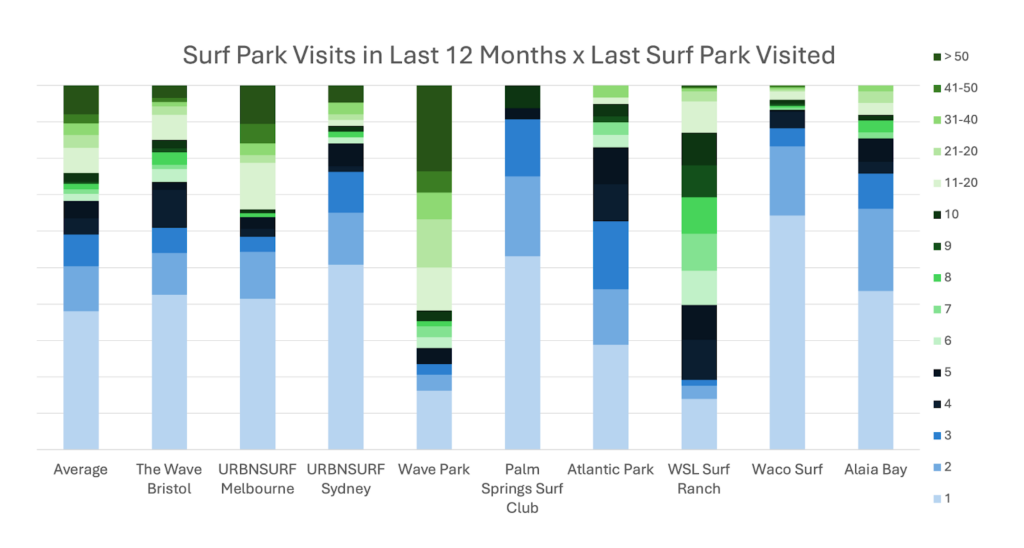
58% of all participants in our 2025 survey said they are likely or very likely to visit a surf park in the next 12 months, representing a 21% increase from 2024. At the same time, a substantial portion of demand continues to come from occasional participants. These users are often less familiar with how sessions are structured, may be more constrained by schedule or price, and are less predictable in their booking behavior. The coexistence of these two groups introduces a segmentation challenge that operators must actively manage.
One response to this challenge is already visible in the data. Approximately 35% of respondents report purchasing memberships or bundled sessions, indicating that surf parks are beginning to convert a portion of their customer base into more consistent, repeat participants. In this context, memberships function as a tool for shaping demand, helping operators influence when and how customers engage with the facility.
The Economics of Filling Sessions
The structure of surf park operations creates a distinct economic reality. Each session represents a fixed unit of capacity that cannot be recovered once it passes. If a session is underfilled, that inventory is permanently lost.
The 2025 dataset highlights how varied customer behavior is within this constraint. Mean spending on surf sessions is approximately $294, while the median is closer to $125, indicating a wide spread between higher-value and more price-sensitive customers. Non-surf spending follows a similar pattern.
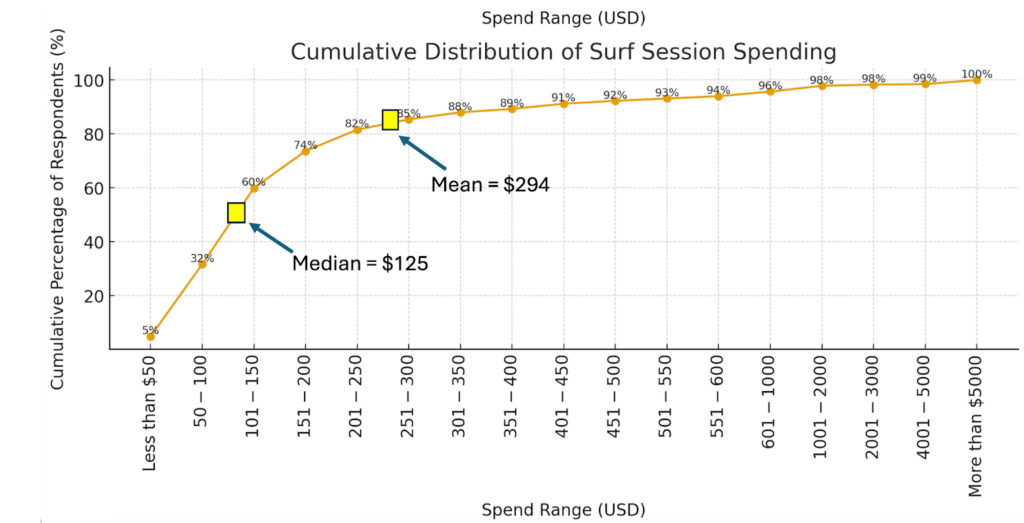
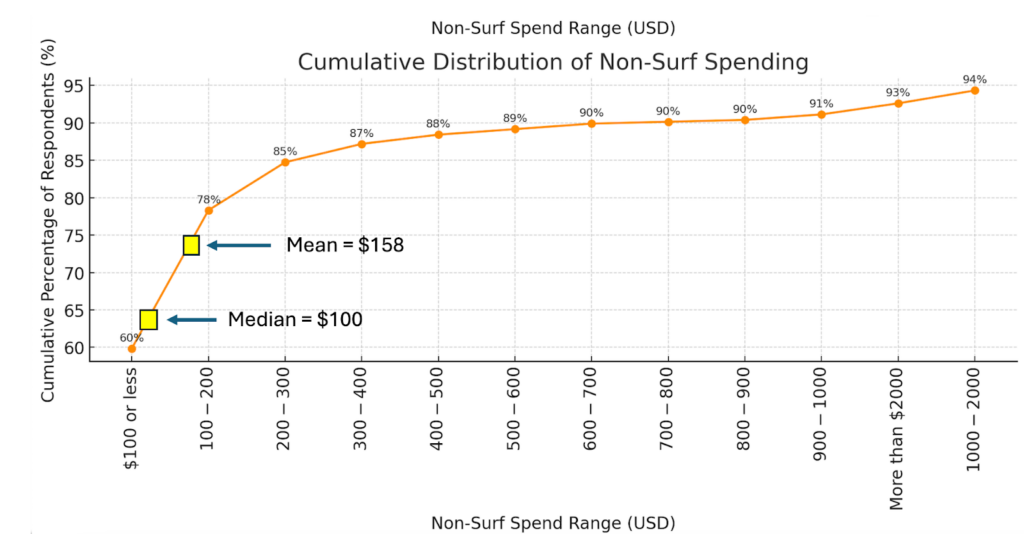
This distribution reflects the diversity of experiences currently offered within surf parks. Some visitors engage at a premium level, purchasing advanced sessions, coaching, or equipment rentals. Others participate at lower price points, often on a more occasional basis. For operators, this variability reinforces the importance of aligning different customer segments with different session types. Premium offerings must be positioned to capture higher-spending demand, while entry-level and intermediate sessions must remain accessible enough to support broader participation.
The challenge lies in balancing these dynamics across a fixed schedule. Maximizing utilization is not simply a matter of increasing prices or increasing volume. It requires careful calibration of session mix, timing, and pricing to ensure that each segment of demand is effectively matched to the appropriate product. As surf parks become more localized and repeat-driven, this balancing act becomes more complex. Customers who view surf parks as part of their regular routine bring different expectations around availability, convenience, and flexibility. Meeting those expectations while maintaining high utilization rates requires a more deliberate and data-informed approach to programming.
An Industry Learning in Real Time
The surf park industry is now entering a phase that many other recreation sectors have experienced: refining the operating model. What distinguishes surf parks is the speed at which this transition is occurring. With dozens of new facilities expected to open in the coming years, operational knowledge is being generated rapidly and across multiple markets simultaneously. Decisions about session structure, pricing, and programming are being tested in real time.
This environment increases the importance of shared learning. In recent years, Surf Park Central began hosting a standalone committee of experienced surf park operators at Surf Park Summit to discuss and share best practices. In 2025, this committee resulted in the first ever Surf Park Minimum Safety Standards Agreement, which was signed by 12 surf parks with an agreement to fully implement the plan by November 2026.
Rather than operating in isolation, operations managers are increasingly sharing insights on scheduling, programming, and understanding demand and managing supply. This collaborative dynamic will be a central feature of Surf Park Summit 2026, where members of the operator community will step beyond closed door internal discussions and present their findings through a series of panels and presentations. Topics will include the evolution of membership models, strategies for improving session utilization, and the practical challenges of balancing premium experiences with broader accessibility.
The Next Phase of Surf Parks
The surf park industry has moved beyond the question of whether artificial waves can be built and operated. That phase, while foundational, is no longer the primary source of uncertainty. The next phase is defined by how effectively those waves are utilized. As demand becomes more localized and routine, a segment of high-frequency users is emerging alongside a broader base of occasional participants, creating a more complex and segmented demand profile within a system constrained by fixed capacity.
These dynamics shift the focus of the industry. The challenge is no longer generating interest, but aligning demand with a structured schedule of surf experiences in a way that consistently fills sessions and supports sustainable operations. How the industry responds will shape the next generation of surf parks and determine how widely they expand.









You must be logged in to post a comment Login