The list of wave technologies has grown since the industry started rapidly expanding. But one company has remained as a go-to source for waves: SurfLoch.
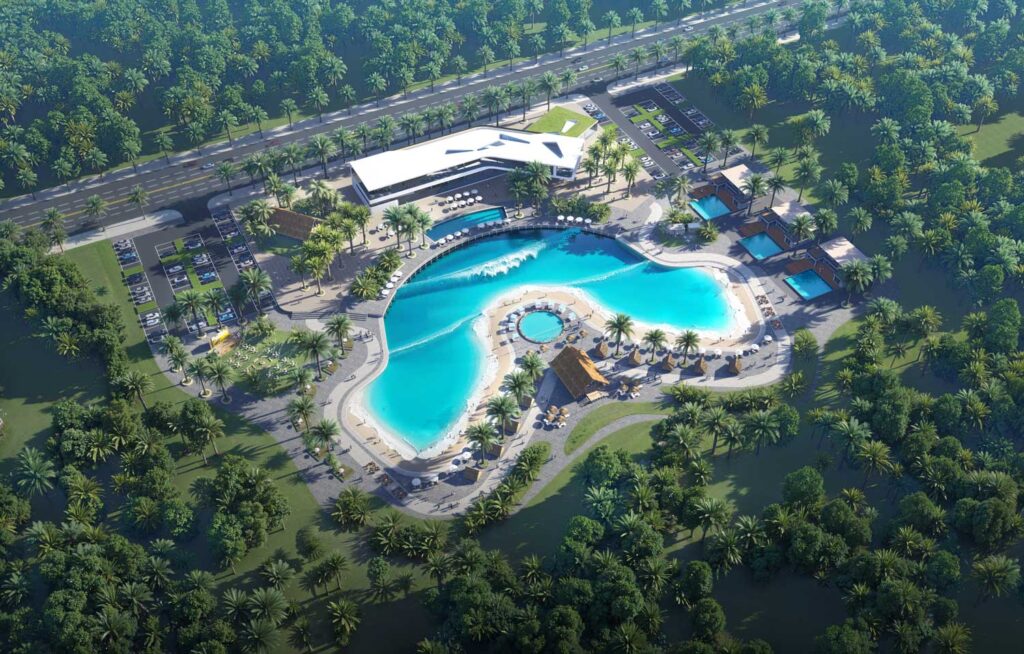
The company’s history is tied to its founder, Tom Lochtefeld, who’s been a pioneer in creating human-made waves. More recently, the company has unleashed multiple new designs and concepts to fit the needs of a wide range of developers.
Surf Park Central spoke with founder Tom Lochtefeld, as well as Ranney and Logan Lochtefeld, about the evolution of the industry and where it stands now.
Surf Park Central: Who are the primary developers building surf parks today, and what does that landscape look like?
Tom Lochtefeld: It helps to separate two roles that are often conflated. The developers control the land, assemble the capital, and carry the real estate; the wave-technology providers—SurfLoch among them—supply and sometimes help operate the wave. Choosing a wave partner is one decision within a far larger undertaking.
The developer field is broader and more professional than five years ago, spanning real estate developers using a wave as an anchor amenity, hospitality groups, standalone leisure operators, surfer-founders paired with construction expertise, and institutionally backed platforms pursuing several sites. The activity is substantial, and two structures dominate—the standalone destination, where the wave must carry the business, and the faster-growing surf-anchored real estate model, where the wave is an amenity whose value is distributed across residential pricing, absorption, and retail and hospitality yield.
Surf Park Central: What are the most common challenges or misconceptions developers first bring to SurfLoch?
Tom Lochtefeld: The wave is not usually the only project. In most schemes, the wave system is a minority of total cost—a pool plus buildings runs on the order of $50 million before land, closer to $100 million with hospitality, and $150–$200 million with larger real estate holdings. The land, sitework, buildings, and infrastructure carry the majority of the budget and much of the schedule risk.
Wave count is not revenue. Returns are driven by utilization, programming, pricing, and yield sustained over years, not by peak waves per hour; the wave must be matched to a business model, not the reverse.
Sitework risk is underestimated. Publicly reported projects have seen geotechnical conditions such as a high-water table drive costs up by more than twenty percent, and sector construction costs have risen materially—we treat that escalation as a base case, not a tail risk.
A wave provider is an operating partner, not a one-time vendor. Programming, maintenance, spare parts, and energy management persist for the life of the asset; because we operate our own pools, we raise those realities early.
Design alignment cannot wait. The wave program suited to a progression-focused club differs from one for high performance, competition, or family leisure, and aligning design with the business model early costs far less than retrofitting it later.
Ranney and Logan Lochtefeld: Honestly, the vision—and a realistic one. You need to understand the cultural anchor you’re building around and who you’re actually building it for, but vision without numbers is just a nice rendering. The developers who succeed are realists who still reach for the stars: they know their site, their market, their costs going in. They sweat the details before submission, not after. They know surf culture, or they’re honest enough to bring in someone who does. That combination—ambition with discipline—is rarer than people think, and it’s also easier to pull off in an industry this young, before “the way it’s done” hardens into rules.
Surf Park Central: What do successful developers bring to the table that enables a great surf park?
Tom Lochtefeld: The projects that go well share a recognizable set of foundations: site control and a credible entitlements path through zoning, water, power, and environmental review; a funded, patient pre-development budget; a validated business model that identifies the customer and lets us specify a fitting wave program; an experienced team with genuine local and community engagement; early engagement with the wave partner during design rather than after the layout is locked; a real commitment to operations—staffing, coaching, safety, programming, and energy planning; and values alignment, since we do our best work with partners who share a long-term, quality-first orientation and care about the surfing experience as much as the pro forma.
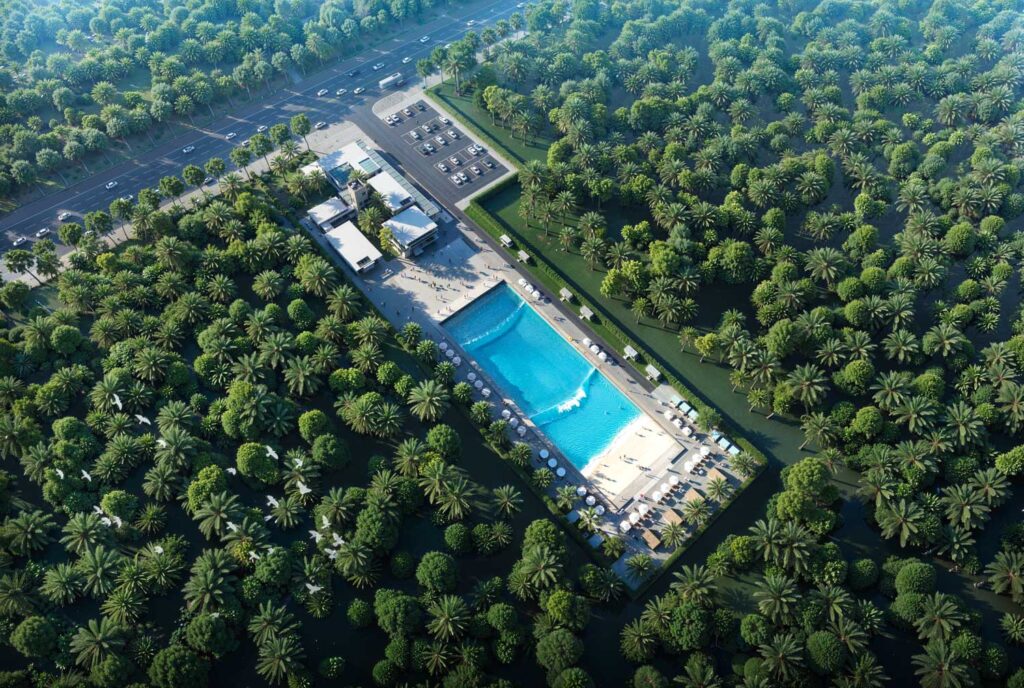
Surf Park Central: When does capital need to be in place, and what does the funding timeline look like?
Tom Lochtefeld: The single hardest part of surf park capital is not construction financing but the pre-development phase that precedes most institutional engagement. Industry panelists put the soft costs needed before larger partners commit at roughly $3–4 million for a standalone project; some developers fund early phases with $1–2 million per project from family offices before raising project-level equity and debt. That early capital is patient, relationship-driven, and high-risk—investors are underwriting the people more than any stabilized return.
As a general sequence—every deal differs—projects secure land control, work through entitlements (frequently twelve to thirty-six months or more), complete design and engineering, close the capital stack, build over roughly eighteen to thirty months, then commission and open, for a total of three to six years and often longer. Equity generally must be committed before entitlement risk is retired enough to attract construction debt, which typically closes near the start of vertical construction; because certain wave components carry long lead times, we recommend ordering earlier than developers expect, and carrying meaningful contingency against documented cost escalation.
Surf Park Central: What are the core steps required to successfully take a surf park from concept to completion?
Ranney and Logan Lochtefeld: Secure the property, secure the entitlements, then build the thing: design, engineering, permitting, construction, leaning on the people we bring to the table—architects, contractors, integrators, us. We’ve shepherded clients through every one of those stages, start to finish. Patience is a prerequisite, though at a certain point you could just call it determination. We’ve worked with clients who came to us with nothing more than an idea and are now surfing daily in their own pool. Our door’s open at any stage—concept, mid-build, or somewhere in between.
Surf Park Central: Anything else aspiring developers would want to know that SurfLoch could assist with?
Tom Lochtefeld: Our involvement need not stop at the wave system. With 40 years of experience in development and operation of water attraction, we can support feasibility and modeling designed to match the business model. We encourage developers to engage a wave partner early and to plan candidly for the pre-development phase that so often determines whether a project reaches the water. SurfLoch has long embraced unique and challenging projects, ocean or inland, and we look forward to continuing these conversations at Surf Park Summit 2026 in Virginia Beach.
Logan Lochtefeld: This is a family business, and it’s been ours for decades—Tom helped build this industry from the beginning, and a lot of what other companies run on today traces back to patents and people who started here. That history matters to me, but so does where it’s going: “built by surfers for surfers” was never about gatekeeping who gets to call themselves a surfer. It’s about giving more people the chance to become one. I grew up around this culture, and nothing replaces the ocean—but I’ve also watched people catch their first wave in one of our pools and get hooked the same way I did. If you’re thinking about building one of these, we’re a system integrator ourselves, full-service or hands-off, whatever you need. Talk to us early. And remember: bigger doesn’t always mean better.







You must be logged in to post a comment Login