By Jess Ponting
Behind every surf park project is a set of financial decisions that rarely make the headlines. The structuring of ownership and capital for each project is a unique three-dimensional puzzle that influences everything from leverage to long-term returns. Solving it is among the greatest challenges a surf park developer will face.
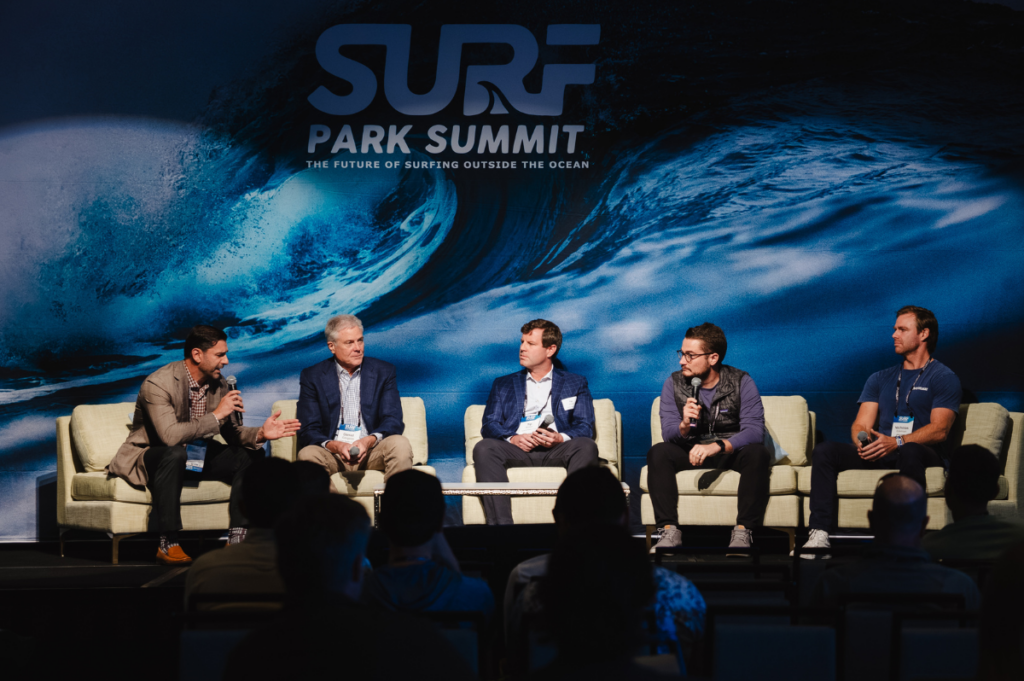
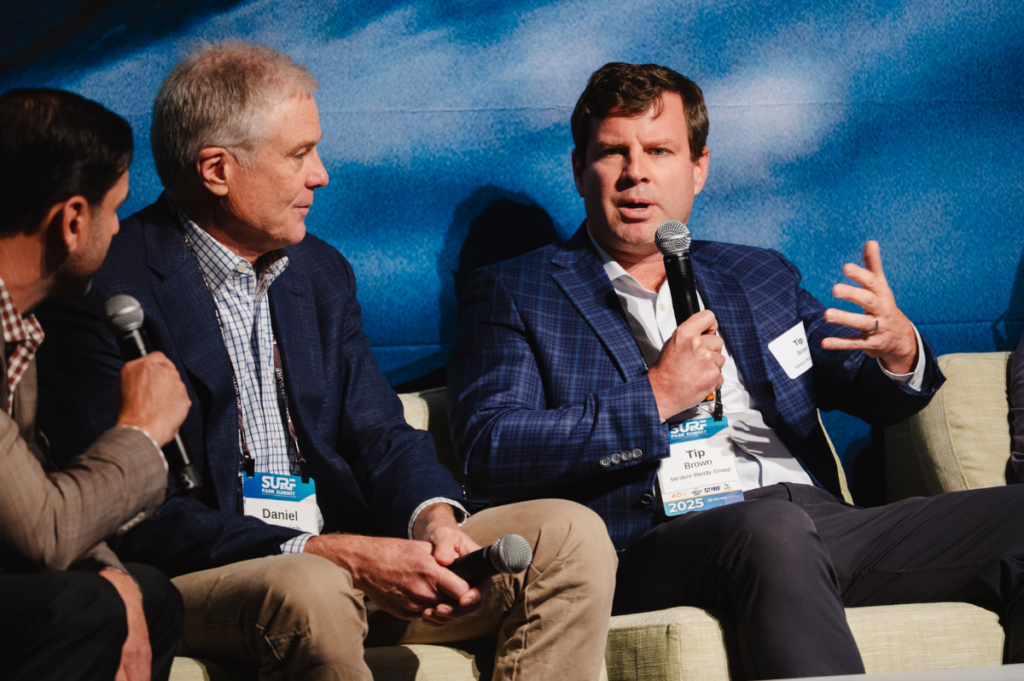
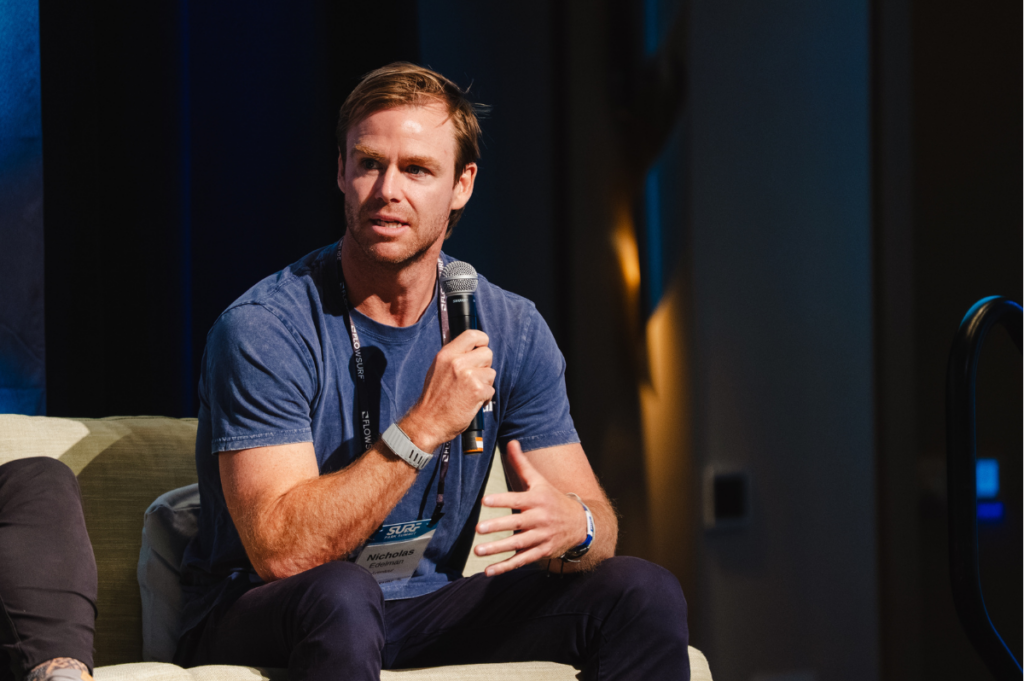
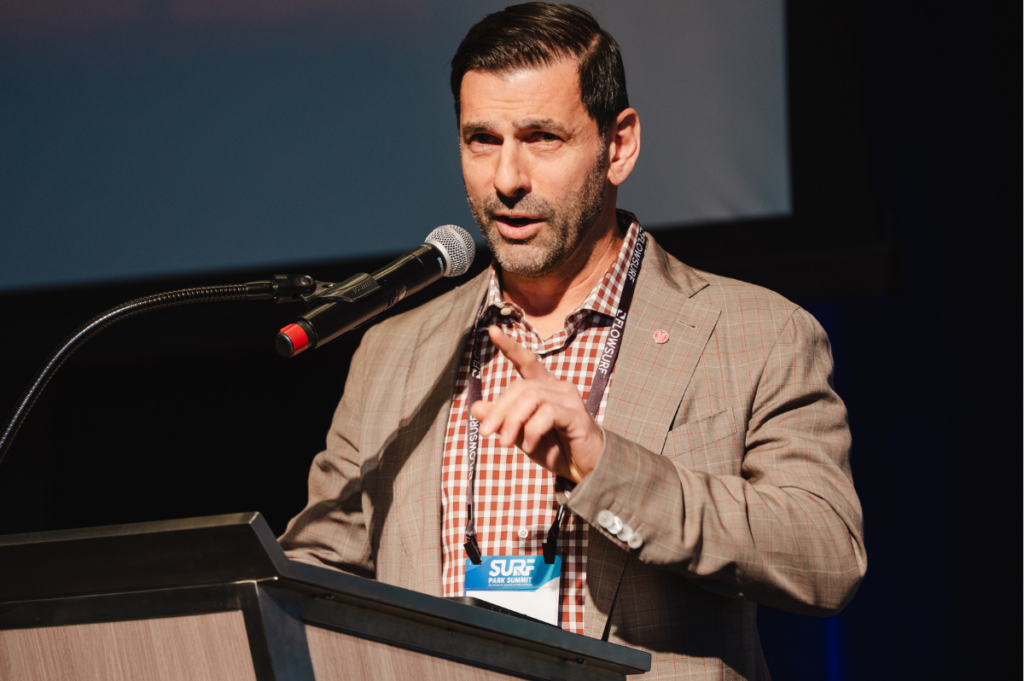
Surf Park Summit 2025 addressed this pain point with a panel titled “Funding the Dream: How Developers are Financing Surf Parks”. Using a hypothetical $100 million surf park as a baseline, moderator Orion Corcilius (Managing Partner at Vandever Capital), led panelists Dan Gangwish (Managing Director at Piper Sandler), Brent Templeton (EPR Properties), Tip Brown (Venture Realty) and Nick Edelman (CEO & Co-Founder at Aventuur) through how real projects come together—and where most developers get stuck.
The discussion touched on why the earliest stages of development require years of patience and upfront capital before institutional investors engage; what capital providers are truly evaluating—team, track record, and real estate fundamentals—alongside the evolving role of sponsors and balance sheets in an emerging asset class. The conversation also highlighted the importance of municipal participation, the increasing reliance on data-driven site selection, and the role of mixed-use development in strengthening project economics. Just as importantly, it underscored how these deals are assembled in pieces, with different layers of capital supporting different components of the project.
We derived 10 key insights drawing directly from the panel discussion to illustrate how surf park projects are being structured in today’s market.
Insight 1. Ownership Isn’t Binary—It’s Strategic
One of the first distinctions the panel made was: do you own the real estate, or just operate the business? For groups like EPR, the answer is clear. They want to own the dirt—the land and physical improvements—while operators retain control of the business. This “PropCo / OpCo” split allows operators to stay focused on delivering the experience, while real estate investors underwrite long-term, stabilized cash flow.
For developers, this creates optionality. Owning both the asset and the operation may feel intuitive, but it can also tie up capital in a specialized asset with limited alternative use. Separating the two can unlock higher leverage and reduce balance sheet pressure. At the same time, compared to hotels or golf courses, lenders are cautious. Where a traditional asset might secure 60–70% leverage, surf parks today are often seeing 25–35% leverage from banks, forcing developers to fill the gap with equity or alternative structures.
Takeaway:
More than a legal decision, ownership structure is a capital strategy. Separating real estate from operations can be the difference between a financeable deal and a stalled one.
Insight 2. In the Early Years Developers Carry the Risk
Before capital partners show up, developers are on their own. In the case of Atlantic Park, this meant six years of funding pre-development costs—from initial RFP through closing—entirely with GP equity. For a standalone surf park, panelists estimated $3–4 million in soft costs just to reach the point where larger capital partners will engage. Aventuur’s experience was similar, albeit structured differently. By tapping family offices as early-stage “venture-style” capital, they funded early development phases with $1–2 million per project before raising project-level equity and debt. Across both approaches early capital is patient, relationship-driven, and high risk. At this stage investors are underwriting the people behind the project rather than stabilized returns.
Takeaway:
The biggest funding gap in surf park development isn’t construction—it’s the first few years and several million dollars of pre-development. If you can’t survive this phase, you won’t attract larger capital partners.
Insight 3. What Capital Actually Cares About
Developers often assume capital is focused on projections, models, or market demand. The panel made it clear that’s not where deals live or die. From both advisory and investor perspectives, three filters dominate:
· Can you build it? (Track record delivering physical assets)
· Do you have equity? (Skin in the game and capital partners)
· Will it operate? (Can the business generate and sustain cash flow?)
Beyond that, investors emphasized three additional factors:
· The team (you’re betting on the jockey, not the horse)
· The real estate (A+ locations can offset operational risk)
· The structure of the capital stack (who gets paid first—and how)
Interestingly, the “surf” and lifestyle component itself barely registers in the first pass.
Takeaway:
Investors will only fund a surf park if they believe the team can build it, operate it, and survive when things go wrong.
Insight 4. The Role of the Sponsor
At some point, every project needs to figure out who signs the loan. Traditional project finance expects a sponsor with a balance sheet large enough to backstop construction risk and completion guarantees. But surf parks are pushing into structures where that model doesn’t always cleanly apply. Aventuur’s approach highlights this shift. Instead of relying solely on a single sponsor, they combined:
- Ultra-high-net-worth individuals
- Institutional equity partners
- Non-recourse debt structures
In these cases, the “guarantee” becomes more implicit than explicit. Large equity partners may not be legally obligated to step in—but they are economically motivated to protect their position. This creates a middle ground between traditional recourse-backed deals and fully non-recourse structures.
Takeaway:
The surf park industry is quietly rewriting sponsor requirements. Strong deals with aligned capital can substitute for a single dominant balance sheet—but only if the underwriting is airtight.
Insight 5. Municipal Financing: The Hidden Layer That Can Change Everything
Municipal support is an underappreciated driver of surf park feasibility. At Atlantic Park, roughly $120 million of the $350 million project came from municipal bond structures tied to tax increment financing (TIF) and related mechanisms. That capital didn’t come from the developer’s pocket—and didn’t require direct repayment in the traditional sense. Instead, it’s repaid through future tax revenues generated by the project itself. That doesn’t mean it’s free money. It’s highly structured, often restricted to infrastructure (like parking), and comes with complexity. For example, some tax-exempt debt cannot include equity. Despite the restrictions, the impact has been enormous. Without this capital instrument, the project’s feasibility changes dramatically.
Takeaway:
Municipal financing can be the difference between a viable project and one that never pencils. Engaging cities early is crucial.
Insight 6. Site Selection Requires Data Over Intuition
Surf parks may feel experiential and intuitive, but site selection is increasingly analytical. Aventuur described a process that starts with city-level regression analysis—population trends, tourism flows, climate data—before narrowing down to micro-locations using:
- Drive-time analysis
- Consumer spending data (via credit card datasets)
- Land price overlays
The goal is to maximize demand while minimizing land basis because event a great and well-run surf park could lose money if the developer overpaid for land.
Takeaway:
The best surf park site isn’t the most obvious one—it’s the one where demand, access, and land cost align. Getting the land basis wrong is an existential risk.
Insight 7. Mixed-Use Is the Real Business Model
The panelists agreed that the surf park is rarely the main financial driver.At Atlantic Park, the surf lagoon is the centerpiece, but it is not the largest economic engine. Multifamily, retail, entertainment venues, and hospitality all contribute to the overall return.Aventuur echoed this approach across its portfolio, highlighting the importance of multifamily housing adjacent to parks, retail and hospitality components, and even industrial uses (like data centers) to unlock land value. Aventuur went a step further in the New Zealand project by selling part of the land to a data center developer and then using that capital to fund the surf park. The added bonus of this arrangement is that using waste heat from the data center can be used to warm the surf lagoon.
Takeaway:
If your surf park is the only revenue driver, your deal is fragile. The strongest projects recognize that the lagoon is an anchor, not the entire business.
Insight 8. Financing Isn’t One Deal, It’s Many
Large surf park developments are not financed as a single transaction. For example, Atlantic Park broke its capital stack into multiple pieces:
- Revenue bonds for the surf park
- TIF-backed financing for infrastructure
- Separate bank loans for multifamily and retail
- Local financing for ancillary buildings
Different lenders have different mandates, and trying to bundle everything into one deal often leads to rejection.
Takeaway:
Pitching $300 million deals may be less effective than structuring $30–70 million components that match investor mandates.
Insight 9. The Industry Is Early—And That’s the Opportunity
The panel highlighted a great deal of uncertainty in the industry given limited operating data, conservative lending practices, and new and emerging underwriting models. For investors, that uncertainty translates to caution while for developers, it translates to higher equity requirements and more complex capital stacks. However, it also signals upside. As more parks are built and performance data becomes available, leverage will increase, capital will get cheaper, and institutional participation will expand.
Takeaway:
Surf parks are being priced like experimental assets—but they won’t stay that way. The groups that solve capital structure today will be positioned to scale when the market catches up.
Insight 10. Surf Parks Are Not a Surf Problem
For all the talk of waves, technology, and experience, this panel made clear that surf parks are not a surf problem. They’re a capital problem. The groups that really figure that out will be the ones that succeed and define the industry.











You must be logged in to post a comment Login