By Jess Ponting
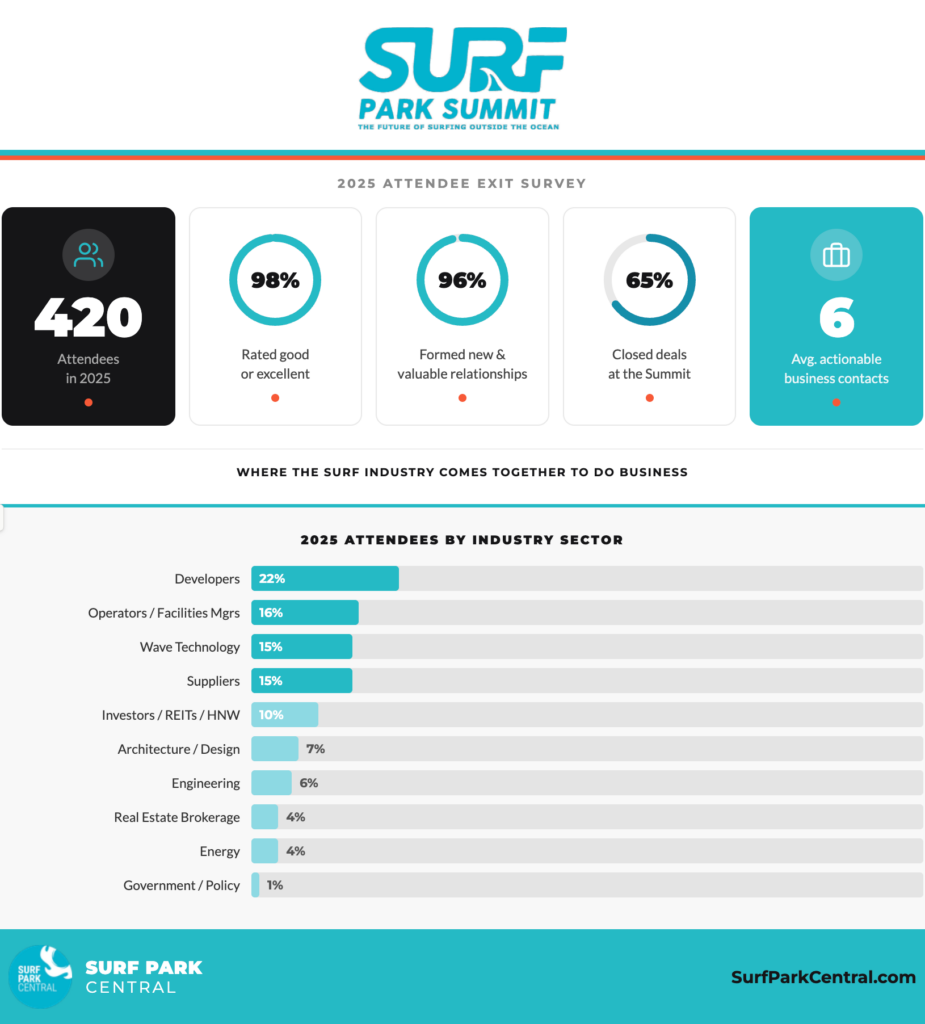
Surf Park Summit 2025 attracted 420 attendees from across the global surf park ecosystem, including developers, operators, investors, wave technology companies, architects, engineers, and suppliers. The post-event survey revealed high satisfaction rates, strong business outcomes, and meaningful cross-sector engagement. As the industry continues to grow and mature, Surf Park Summit has become the place where the entire industry gathers, partnerships are formed, deals are advanced, and the future direction of the industry is charted.
Surf Park Summit 2026 is shaping up to be an even more important gathering.
Earlier this year, we identified five emerging themes shaping the next phase of surf park growth: evolving business models, surf-anchored real estate, more sophisticated capital strategies, operational optimization, and a growing emphasis on translating projections into real-world performance. Surf Park Summit 2026 arrives at precisely the right moment to explore what this evolution means.
Returning to Virginia Beach from Sept. 1–3, the Summit reflects an industry that is growing rapidly while simultaneously becoming more complex. A dozen surf parks opened during 2024 and 2025, roughly ten more are expected to open before the end of 2026, and dozens of additional projects continue to move through planning, approvals, financing, and construction. With the question of whether surf parks can work largely been answered, the industry is now focused on how surf parks can create the greatest long-term value for developers, operators, investors, communities, and guests.
What becomes immediately apparent when reviewing this year’s program is that the industry’s center of gravity is shifting. While wave technology remains fundamental, an increasing share of the conversation is centered on components beyond the wave itself. Membership models, residential development, hospitality, retail activation, capital strategy, operational performance, destination placemaking, safety, and community integration now occupy center stage. In many respects, the surf lagoon is evolving from the primary business into the anchor amenity around which much larger and more diverse business ecosystems are being built.
From Surf Parks to Surf-Anchored Destinations
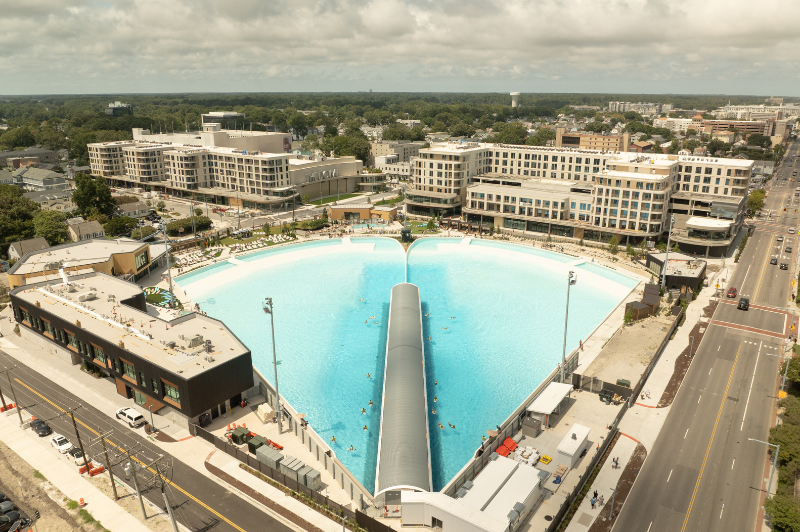
This evolution is deeply reflected in this year’s Summit programming and will be the first thing attendees experience firsthand, even before the conference begins, through the Atlantic Park Surf walking tour. More than an opportunity to examine wave technology and operations, the tour provides a real-world look at how surf parks are being integrated into broader environments that combine recreation, hospitality, residential, entertainment, and commercial uses.
This shift is by no means unique to surf parks and mirrors patterns seen across other amenity-driven real estate sectors. Golf courses, for example, often create more value through adjacent real estate than through green fees. Ski resorts became catalysts for entire mountain communities. Marinas transformed waterfront developments. Increasingly, surf parks appear to be following a similar trajectory, serving as anchor amenities that influence residential pricing, hotel performance, retail activity, destination appeal, and overall project differentiation.
Summit programming exploring surf-anchored real estate, public-private partnerships, mixed-use development, destination creation, and capital strategy all point toward a future where developers are evaluating surf parks as placemaking tools. New questions have emerged as a result. How much value does a surf park create for the surrounding residential inventory? How should access be structured between residents, members, hotel guests, and the public? Does the lagoon operate as a profit center, or is its greatest contribution found in supporting broader development objectives? How does adjacency to a surf lagoon impact retail square footage rental rates and hotel REVPAR and occupancy? These are the topics shaping projects around the world, and they represent one of the most significant developments occurring within the industry today.

From Selling Sessions to Building Communities
The industry’s evolving approach to memberships provides another window into its future. Early surf parks were largely built around session sales and day-use visitation. While those remain important revenue streams, operators are increasingly experimenting with models designed to create deeper and longer-lasting relationships with customers.
Private clubs, hybrid membership structures, premium access programs, and founder memberships are becoming more common across the global project pipeline. What makes this trend particularly interesting is that memberships influence far more than revenue generation. They are increasingly being used to validate demand before construction begins, generate early-stage capital, improve utilization, and foster community identity. In some projects, memberships are becoming as important to the business model as the waves themselves.
This shift also aligns with a broader industry focus on operational performance. Every surf park operates with a finite inventory of wave time, and maximizing the value of that inventory has emerged as one of the industry’s most important disciplines. Operators are refining pricing strategies, experimenting with dynamic programming, balancing peak and off-peak demand, and developing increasingly sophisticated approaches to customer segmentation and retention. As more parks accumulate operating history, the conversation is moving beyond occupancy and attendance toward optimization and yield.
The implications extend beyond financial performance. Surf parks are increasingly discovering that their most valuable customers are highly engaged community members who return frequently, participate in events, purchase memberships, bring friends, and contribute to the culture of the venue. Successful operators are learning that they are building communities around surfing.
From Concept to Operational Maturity
Only a few years ago, there were relatively few people in the world who had actually opened and operated a surf park. Today, there is a rapidly expanding body of experience generated by developers, operators, engineers, designers, investors, and suppliers who have navigated the realities of bringing projects to life.
That experience is producing valuable insights around safety, operations, design integration, capital strategy, construction execution, and long-term performance. One of the clearest lessons to emerge is that successful surf parks cannot treat these elements independently. Design decisions influence operations. Operations influence safety. Safety influences guest experience and long-term viability. The most effective projects increasingly approach these functions as an integrated system rather than a collection of separate disciplines.
The same is true for development itself. While public attention tends to focus on opening day, experienced developers understand that many of the most consequential decisions occur years earlier. Community engagement, entitlement strategies, permitting processes, engineering coordination, budgeting, construction sequencing, and stakeholder alignment all play critical roles in determining project outcomes. As more projects move from concept to operation, the industry is beginning to identify common patterns, recurring challenges, and proven approaches. That collective learning process is becoming one of the industry’s most valuable assets.
Those lessons are also influencing how projects are financed. As surf parks become more deeply integrated into larger developments, capital structures are becoming increasingly sophisticated. Developers are combining equity, debt, memberships, hospitality revenues, residential components, sponsorship opportunities, and commercial leasing strategies in ways that were far less common only a few years ago. Investors now have access to a growing body of operational data and completed projects, allowing conversations about capital to move beyond speculation and toward a more informed understanding of risk, return, and long-term value creation.
Why Surf Park Summit Matters Now
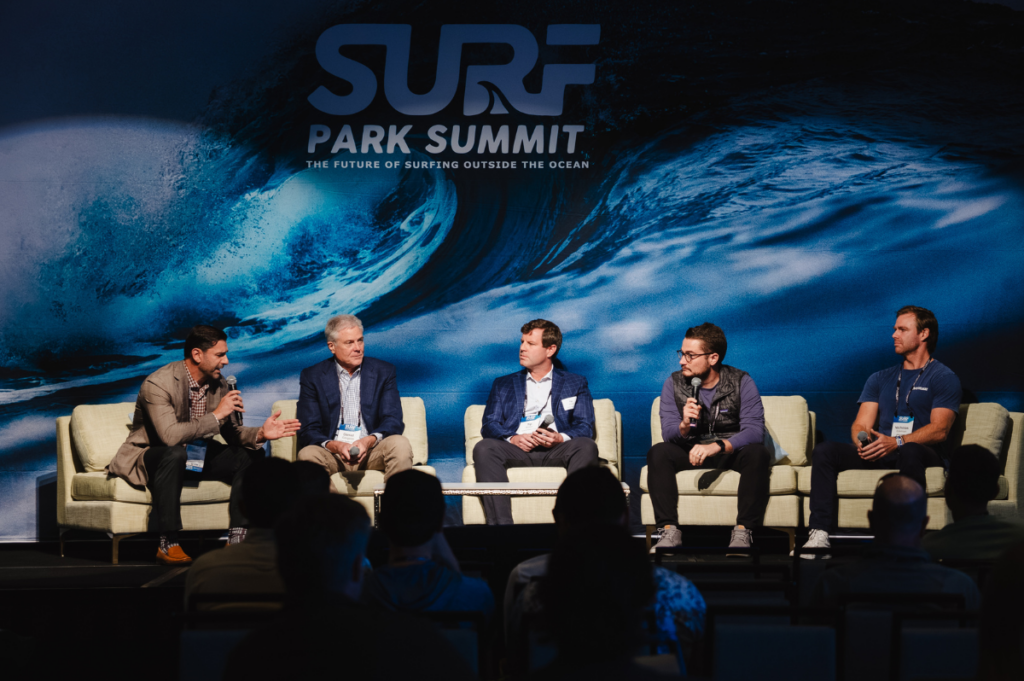
Taken together, the incorporation of these developments into the Summit programming helps explain why Surf Park Summit 2026 may be the industry’s most relevant gathering to date. The event is not just a place to learn about wave technologies or hear project announcements, though it is that as well. The event has evolved into a working forum for an industry that is actively defining its future.
Beyond the core program of panels and presentations, Atlantic Park activations, developer workshops, operator committee meetings, technology showcases, Surf Park Sharks, and the Surf Park Awards create opportunities for collaboration, debate, and knowledge sharing. The people making decisions across every segment of the surf park ecosystem—developers, operators, investors, suppliers, designers, engineers, technology providers, and public-sector leaders—will be in the same place discussing the opportunities and challenges that will shape the next decade of growth.
For developers, that means learning from those who have recently navigated the path from concept to opening day. For operators, it means sharing strategies around utilization, programming, safety, and performance. For investors, it means gaining perspective on an increasingly sophisticated asset class. For suppliers and service providers, it means engaging directly with the people shaping projects around the world and identifying where opportunities are emerging.
Earlier this year, we argued that the surf park industry had moved into a phase defined by optimization, integration, and long-term value creation. Surf Park Summit 2026 suggests that the transition is happening faster than many anticipated. The next generation of surf parks will not simply be larger versions of the first. They will be more integrated, more sophisticated, and more deeply connected to broader destinations, communities, and business ecosystems.
The decisions that shape those future projects are being made in real time. Most of the people making them will be in Virginia Beach this September. Surf Park Summit 2026 is where those conversations will take place.








You must be logged in to post a comment Login